

AI in Property Development: What It Actually Means for South African Developers
AI in Property Development: What It Actually Means for South African Developers in 2026
The word “AI” is everywhere right now. In boardrooms, at industry conferences, in every technology newsletter your sales director has quietly ignored.
For most South African property developers, it means one of two things: a vague sense that they should probably be doing something with it, or a chatbot they tried once that didn’t quite land as expected.
Both responses miss what’s actually happening.
AI is not a single tool. It’s not a chatbot. It’s not a gimmick for early adopters and tech enthusiasts. In the context of property development in 2026 and beyond, AI is a genuine structural advantage — for the developments that understand how to apply it.
The developments using AI well aren’t doing something exotic. They’re using it to do things every development team already needs to do: respond to buyers faster, qualify leads more intelligently, personalise the buyer journey, and make better decisions with their data.
What’s different is that they’re doing these things at a scale and consistency that’s impossible to achieve manually.
This is not the future. It’s happening now. And in South Africa’s increasingly competitive development market, the window for early-mover advantage is open — but not indefinitely.
What AI Actually Means in a Development Context
Let’s set aside the hype and define what AI means specifically for a property development team managing enquiries, sales, and buyer journeys.
In a development context, AI refers to intelligent automation and machine-learning-powered systems that can:
Engage buyers in real-time conversation — across WhatsApp, web chat, and email — without requiring a human to be available
Qualify leads based on behavioural signals — identifying who is serious and who is browsing
Personalise communication — delivering the right message, at the right time, based on what each buyer has shown interest in
Analyse pipeline data — surfacing patterns, bottlenecks, and opportunities that would take a human analyst days to identify
Generate and optimise content — for campaigns, email sequences, WhatsApp messages, and development marketing
None of this requires you to hire a data scientist or build a technology team. A development growth system with AI built into its infrastructure delivers these capabilities through tools your team already uses.
AI for Buyer Engagement: The 60-Second Advantage

Here’s what the developers winning in 2026 and beyond understand that most still don’t.
The moment a buyer submits an enquiry is the highest-value moment in their entire decision journey. Their attention is focused. Their intent is declared. Their emotional investment is real.
And in that moment, most South African developments have a human somewhere — maybe available, maybe not — who will eventually respond.
An AI-powered buyer engagement system changes this completely. When a buyer enquires about a development:
An AI responds within seconds — on WhatsApp, via web chat, or by email
It introduces the development professionally and warmly
It asks qualifying questions — budget, timeline, unit type preference, current living situation
It delivers relevant content — a price list, a brochure, a show house invitation
It escalates to a human consultant at exactly the right moment, with a full brief on what the buyer said and what they’re looking for
The buyer doesn’t feel like they’re talking to a machine. They feel like the development is exceptionally responsive.
The sales team doesn’t lose the critical first-touch window. They inherit a pre-qualified lead — with context — ready for a meaningful conversation.
This is not a chatbot doing basic FAQs. This is intelligent buyer engagement at scale.
AI for Lead Qualification: Know Who Is Ready to Buy
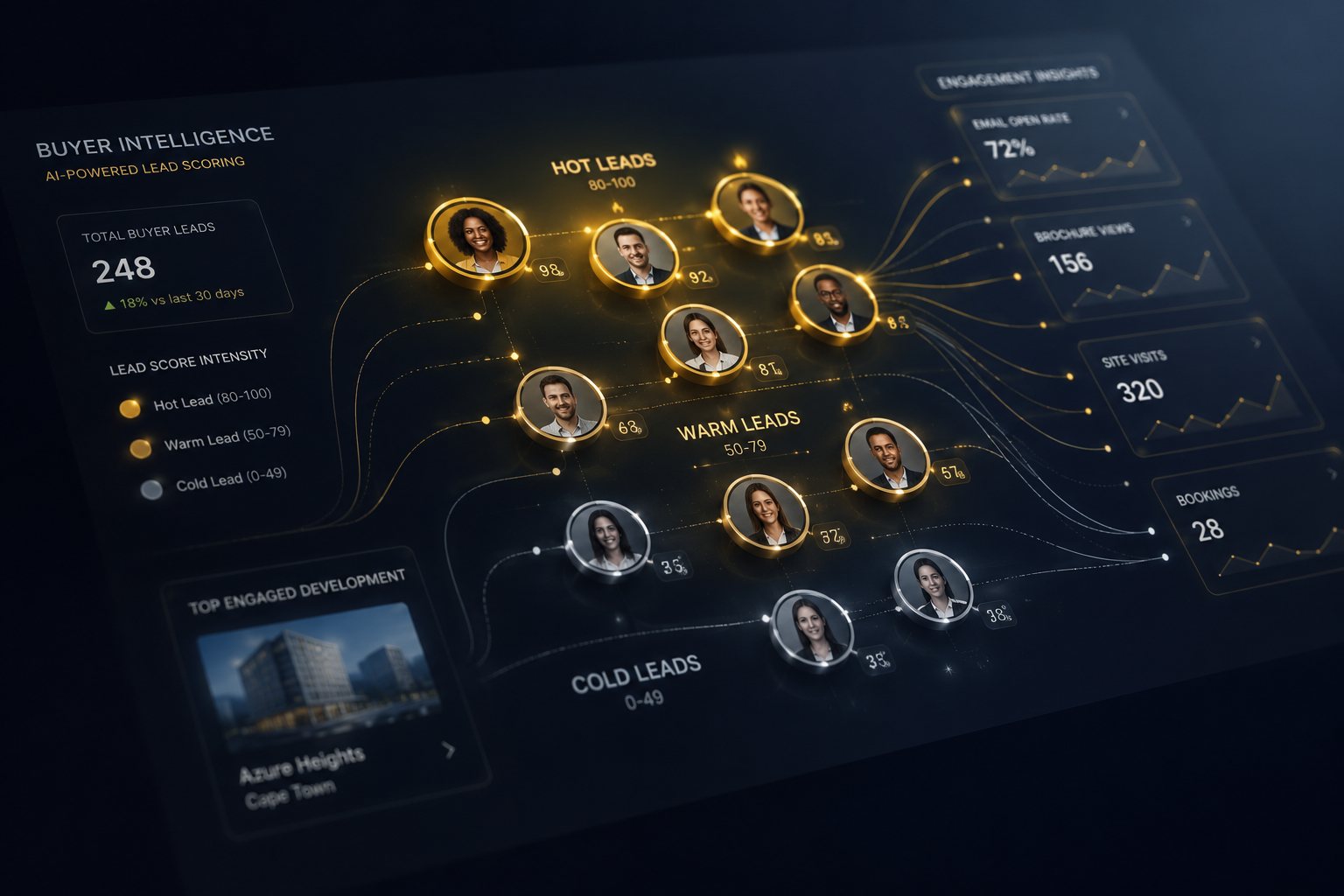
One of the most expensive inefficiencies in development sales is the time consultants spend on buyers who aren’t ready, aren’t qualified, or aren’t serious — while the hot, motivated buyers wait too long for meaningful attention.
AI solves this through lead scoring and behavioural analysis. Here’s what an AI-enabled development CRM tracks:
Enquiry source — where the buyer came from and how warm that source typically converts
Content engagement — which pages they’ve visited, which documents they’ve opened, how many times they’ve returned
Conversation depth — what questions they’ve asked, what they’ve revealed about timeline and budget
Response patterns — how quickly they reply, how engaged they are in conversation
Comparison behaviour — signals that indicate they’re actively evaluating options and therefore closer to a decision
Based on these signals, the system scores every lead — flagging the highest-intent buyers for immediate human follow-up and keeping lower-intent buyers in structured nurturing sequences until they’re ready.
Your sales team stops guessing and starts operating with intelligence. Most developments still rely on gut feel to prioritise leads. This is where AI changes the game entirely.
AI for Personalised Buyer Journeys

Not every buyer in your development is the same.
A 28-year-old first-time buyer enquiring about a sectional title unit has a completely different buyer journey to a 55-year-old couple looking at a retirement estate. A buy-to-let investor has different decision drivers than a family making a lifestyle move. A cash buyer has a different timeline than someone waiting on a bond approval.
Most developments still send the same email sequence, the same price list, the same show house invitation to every enquiry. They call everyone with the same script. They follow up with the same frequency regardless of engagement level.
AI enables personalisation at scale — something that was previously only possible in theory. Based on what a buyer has shared and what their behaviour reveals, an AI-powered development system can:
Deliver different content based on unit type or lifestyle stage interest
Adjust communication frequency based on engagement signals
Personalise WhatsApp messages with relevant development information for each buyer type
Trigger specific nurturing sequences based on buyer life stage and intent signals
Present the development’s most relevant value propositions for each buyer profile
The buyer feels understood. And when buyers feel understood, they trust. When they trust, they move faster toward a purchase decision.
AI for Development Reporting and Insight
Most development directors make marketing and sales decisions based on lagging indicators: last month’s sales report, a pipeline spreadsheet that’s already a week out of date, a campaign debrief that tells them what happened but not why.
AI changes the reporting equation from reactive to proactive. An AI-enabled development reporting layer can:
Identify patterns in enquiry quality across channels and campaigns — telling you not just how many leads came in, but which are converting and why
Predict pipeline health — flagging when current enquiry volume is likely insufficient for your next sales target
Surface at-risk relationships — identifying buyers who have gone quiet and may need re-engagement before they’re lost
Optimise campaign spend in real time — showing which channels generate the highest-quality enquiries at the lowest cost
Track buyer journey velocity — showing where buyers are slowing down or dropping out of the process
This isn’t a 20-page monthly report that nobody reads. It’s actionable intelligence, available in real time, that helps development teams make better decisions faster.
AI for Content and Marketing Efficiency
Development marketing teams spend enormous amounts of time creating content: emails, WhatsApp messages, social media posts, campaign copy, brochure text, website updates, ad creative. It’s repetitive, time-intensive work — and it pulls strategic capacity away from higher-value activity.
AI doesn’t replace this process. But it accelerates it significantly. In a development context, AI can:
Generate first drafts of email nurturing sequences for human review and refinement
Write WhatsApp follow-up messages calibrated to where a buyer is in their journey
Create multiple variations of ad copy for rapid testing
Draft thought leadership content and blog articles that build long-term organic search presence
Personalise template content at scale — adapting generic messages for specific buyer segments automatically
The result: a marketing team that moves faster, produces more, and redirects energy from repetitive content tasks to strategy, brand, and buyer relationships.
The Competitive Window Is Open — But Not Indefinitely
Here’s the honest reality of where South African property development stands with AI in 2026 and beyond.
Most developments are not using AI effectively. Some are experimenting. A few are genuinely ahead. This creates an asymmetric opportunity for developers who act now.
When your development responds to enquiries in 60 seconds while competitors respond in 48 hours, you win attention and trust by default. When your sales team works with scored, qualified leads while competitors’ teams cold-call spreadsheets, you close faster at lower cost. When your buyer journey is personalised and consistent while competitors’ is fragmented and manual, buyers feel the difference before they ever visit a show house.
The developers winning in 2026 are not necessarily bigger or better-funded than their competition. They have better systems. And AI is a core component of those systems.
The window won’t stay open indefinitely. As AI adoption normalises across the industry, the advantage will shift from adoption to sophistication. But right now, the gap between AI-enabled developments and manual ones is significant — and exploitable.
What AI Doesn’t Replace
Before we close, let’s be clear about something important.
AI doesn’t replace the development consultant who builds a genuine relationship with a buyer over six months. It doesn’t replace the show house experience that makes a buyer fall in love with a unit. It doesn’t replace the development director’s market instinct or the sales manager’s ability to close a complex deal.
What AI replaces is the repetitive, time-sensitive, high-volume work that currently falls through the cracks: the missed first-touch response, the forgotten follow-up, the inconsistent nurturing sequence, the 11pm enquiry that nobody answered until Monday morning.
AI handles the systematic. Humans handle the relational. The best development growth systems are built on this principle — automation where it adds speed and consistency, human judgment where it adds trust and genuine value.
What Developers Should Do Right Now
If you’re ready to move beyond experimentation and use AI as a genuine growth driver, here’s where to start:
Audit your first-touch response time. How long does it take to respond to a new enquiry? If the answer isn’t “within 60 seconds,” you have an immediate AI opportunity that can be activated this week.
Identify your lead qualification bottleneck. Are your consultants spending time on unqualified or low-intent leads? AI scoring can change this within weeks of implementation.
Map your current nurturing sequences. Do you have structured follow-up for buyers who don’t convert immediately? If not, AI-powered sequences are the fastest way to build this without adding headcount.
Implement AI buyer engagement on WhatsApp. This single channel, with AI automation behind it, can transform your enquiry-to-conversation conversion rate measurably and rapidly.
Build your AI reporting layer. Real-time pipeline visibility, powered by AI analysis, gives leadership the intelligence to make faster, better, more confident decisions.
Think long-term. AI isn’t a campaign tactic. It’s infrastructure. The developments that treat it as such will compound the advantage with every phase they launch.
Frequently Asked Questions
What is AI in property development?
AI in property development refers to intelligent automation systems — including AI buyer engagement, lead scoring, personalised nurturing sequences, and predictive reporting — that help developers respond faster, qualify buyers more effectively, and manage the entire buyer journey with greater consistency and scale than is possible through manual processes alone.
How does AI help South African property developers?
AI helps South African property developers by enabling immediate buyer engagement within seconds of enquiry, intelligent lead qualification based on buyer behaviour, personalised WhatsApp and email communication at scale, and real-time reporting that surfaces actionable pipeline insights — all without requiring a larger sales or marketing team.
Is AI just a chatbot for property developments?
No. While conversational AI is one visible component, AI in a development growth system also encompasses lead scoring, behavioural analysis, personalised content delivery, automated nurturing sequences, and predictive reporting. The conversational interface is an entry point — the deeper AI layers operate across the entire buyer journey from first enquiry to purchase.
What is a development growth system with AI?
A development growth system with AI is an integrated infrastructure — combining a development website, CRM, WhatsApp automation, AI buyer engagement, and intelligent reporting — that manages the entire development sales process from first enquiry through to purchase, building compounding database and relationship value across phases. Development Funnels builds these systems specifically for South African property developers.
The Developments Using AI Will Compound. The Ones That Don’t Will Catch Up at Cost.
AI is not a future consideration for South African property development. It is a present competitive reality.
The developments adopting intelligent systems today are building an advantage that compounds with every phase, every enquiry, and every buyer relationship they manage through AI-enabled infrastructure.
The developments that are waiting are not standing still. They’re falling behind — slowly at first, then significantly as the gap between AI-enabled and manual operations widens.
The conversation about AI in your development doesn’t need to start with a massive technology overhaul. It starts with one question: what does your current follow-up response look like at 11pm on a Sunday?
If the answer is silence, AI can change that — starting this week. Explore how the Development Funnels AI-powered development growth system works and what it can do for your pipeline.


