

Maximise Enquiries: South African Property Developers' Secret Weapon
Property Development, Lead Management, Buyer Journey, South Africa
What Happens To Every Development Enquiry? The Hidden Cost South African Developers Are Paying
A premium thought leadership look at how South African property developers are losing millions in silent enquiry leakage — and how a system-led approach to property development lead management in South Africa turns every enquiry into a compounding asset.
You've done the work. You've invested in Meta ads, listed on Property24, ran a show day, briefed your agency, and watched the enquiries arrive. The phone rings. The WhatsApp messages come in. The form submissions stack up.
And then — somewhere between the first enquiry and the signed OTP — buyers disappear.
This is the most expensive problem in South African property development right now. Not the cost per lead. Not the ad budget. Not even construction overruns.
It's what happens — or more accurately, what doesn't happen — after the enquiry arrives.
The Enquiry Problem Nobody Talks About
Most development teams are incredibly focused on the top of the funnel. Campaign performance. Lead volume. Cost per enquiry. Click-through rates.
These metrics matter. But they become meaningless if the system behind them can't convert interest into commitment.
The uncomfortable truth is that most South African developments are sitting on a leaking pipeline. Enquiries arrive at one end. Sales trickle out the other. And the space in between — the buyer journey — is largely unmanaged, inconsistent, and human-dependent.
The average response time to a new lead in real estate is over 917 minutes — more than 15 hours. In the context of off-plan property, where buyers are emotionally driven and financially deliberate, that kind of silence sends a clear message: we don't have our act together.
And buyers notice.

When enquiry follow-up is inconsistent, even strong campaigns quietly bleed revenue.
What The Research Tells Us
The data on lead response time is unambiguous and, frankly, should alarm every development director in the country.
Research shows that agents who respond to web leads within five minutes are 21 times more likely to qualify that lead compared to those who wait 30 minutes. Lead response rates decline by a factor of ten after the first hour. A lead contacted within five minutes versus one contacted after 60 minutes shows dramatically different engagement levels.
Now apply that to a typical development context. A buyer submits an enquiry on a Saturday afternoon after seeing your Facebook ad. Your sales consultant is at a show day. By the time someone follows up on Monday morning, the conversion rate has already dropped precipitously. The buyer has moved on — possibly to a competing development that responded faster, or simply lost interest in the emotional window that originally motivated the enquiry.
The top 10% of property sales performers achieve conversion rates approximately three times higher than the industry average. The primary differentiator? Response time and consistent follow-up protocols.
This is not a people problem. This is a systems problem.
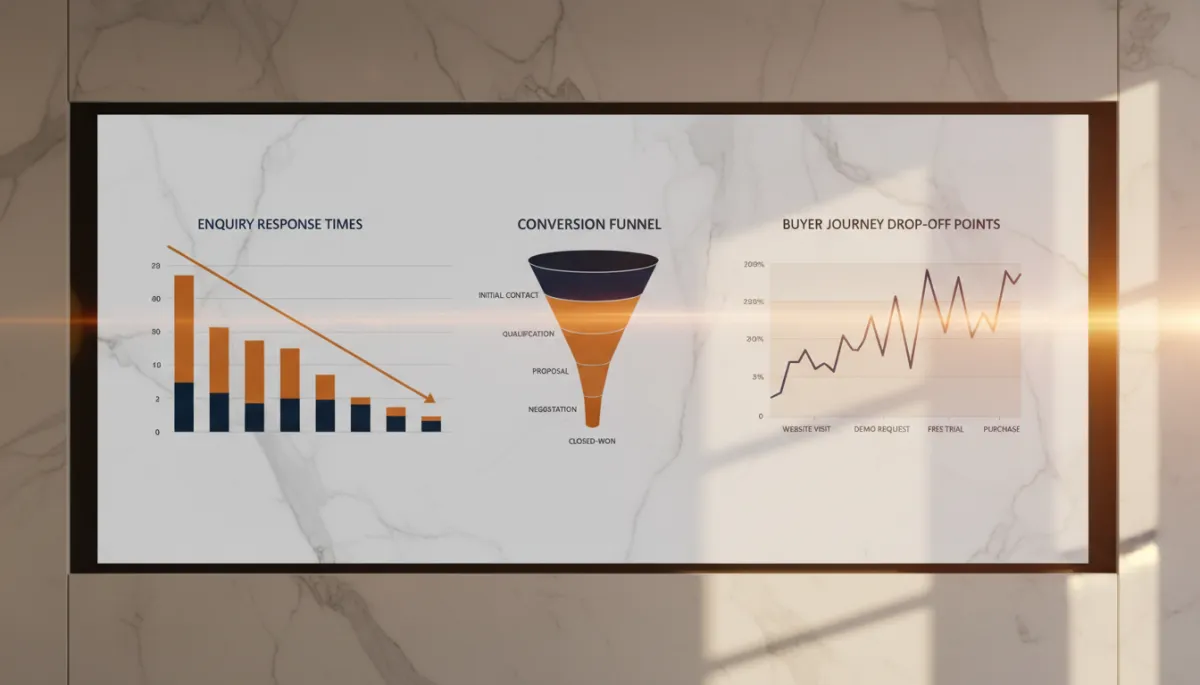
Fast, structured response beats ad spend alone — data makes the gap visible.
The Three Stages Where Enquiries Die
In most South African developments, enquiries are lost at one of three predictable points.
Stage 1: The First Response Gap
The enquiry arrives. Nobody responds immediately. By the time a consultant picks it up, the buyer has already cooled. This is the most common failure point — and the most avoidable.
Most developments still rely on manual follow-up processes. A consultant checks their inbox. They see the lead. They call. Or they don't, because they're busy with another buyer. The outcome is random, not systematic.
Stage 2: The Nurture Void
A buyer enquires but isn't ready to purchase today. They're six months out. They're waiting for a bond approval. They're comparing developments. They need time.
In most developments, these buyers simply fall off the radar. There's no structured follow-up sequence. No automated nurture pathway. No educational content keeping the development top of mind. No WhatsApp touchpoints warming the relationship.
Six months later, that buyer signs at a competing development — one that stayed in contact.
Stage 3: The Database Graveyard
Here's the most painful one. A development completes. The remaining unsold stock is resolved. The marketing goes quiet. And a database of hundreds — sometimes thousands — of interested buyers is archived, exported to a spreadsheet, and effectively abandoned.
When the next phase or next development is launched, the team starts from zero. New campaigns. New spend. New leads. As if the previous database never existed.
This is where the compounding opportunity is destroyed. And this is exactly the problem a Development Growth System is designed to solve.

Treating your database as a long-term asset changes every future launch.
Here's What Developers Are Missing: The Buyer Journey Is a System, Not a Sales Process
The modern development buyer doesn't move in a straight line. From the first enquiry to final registration, property transactions involve multiple stakeholders, complex timelines, and numerous potential points of friction.
A property purchase — especially off-plan — is one of the most considered decisions a person makes. The buyer journey typically spans weeks or months. It involves research, comparison, emotional validation, financial planning, and family consultation.
Most development sales processes are built around a single intervention: the show day or the consultant call. Everything before and after that moment is largely unmanaged.
The developers winning in 2026 and beyond understand that the buyer journey is not a sales process. It's an infrastructure problem. You need to build the roads, not just wait at the destination.
A structured buyer journey for a South African development looks like this:
Enquiry captured — from Meta ads, Google, Property24, Private Property, show day, or referral
Immediate automated response — WhatsApp confirmation within seconds, not hours
AI-powered qualification — buyer intent, timeline, budget, and motivation identified
Consultant handoff — warm lead with context, not a cold call to a name on a spreadsheet
Nurture sequence activated — targeted content, development updates, lifestyle content, and value touchpoints delivered over time
Appointment booking — structured show day or virtual tour invitation
Post-appointment follow-up — automated, personalised, and timely
Sales close support — document checklists, bond origination referrals, OTP facilitation
Post-sale onboarding — buyer satisfaction, referral activation, community building
Database retention — buyer stored, segmented, and primed for future phases
This is not a campaign. This is a system. And systems compound.
The Role of WhatsApp in Development Lead Management
South Africa has one of the highest WhatsApp penetration rates in the world. It is, without question, the dominant communication channel for South African property buyers.
WhatsApp has been making a bigger showing in the marketing mix since early 2024 and is expected to become even more dominant in 2026 and beyond. One WhatsApp chatbot implementation became the top channel for customer engagement within the very same month it was launched, handling thousands of chats per month with queries handled autonomously.
For property developers, this isn't a trend to consider — it's an infrastructure requirement.
When a buyer submits an enquiry on a Sunday evening, the development that responds via WhatsApp within 60 seconds has an enormous advantage over the development that sends an email on Monday morning. Automation makes this possible at scale, without adding headcount.
But WhatsApp automation is only valuable when it's connected to a broader system. A single WhatsApp message without a follow-up sequence, a CRM record, or a consultant handoff is a missed opportunity. The power is in the integration.

Instant, structured WhatsApp replies turn fragile intent into real conversations.
What a Development Growth System Actually Solves
This is where systems outperform campaigns.
A campaign generates leads for a defined period. A system manages, nurtures, and converts those leads continuously — across the entire lifecycle of a development, and beyond it into future phases.
South Africa's PropTech market reached USD 179.74 million in 2025 and is projected to reach USD 526.42 million by 2034, growing at a compound annual growth rate of 12.68%. The infrastructure for smarter development growth systems is no longer emerging — it's here.
A Development Growth System built for South African developers integrates:
A development-specific CRM — not a generic sales CRM, but one built for the stages, timelines, and buyer psychology of property development
WhatsApp automation — instant response, qualification, and nurture via South Africa's primary communication channel
AI buyer engagement — intelligent responses to buyer questions, 24/7, without consultant dependency
Structured buyer journey automation — sequences designed around the off-plan purchase decision, not generic e-commerce logic
Real-time reporting — visibility into enquiry sources, response times, pipeline health, and sales conversion at every stage
Database ownership — every buyer captured, segmented, and retained as a long-term business asset
The result is not just better conversion on the current development. It's a compounding business asset that makes every future phase faster, cheaper, and more effective to launch.
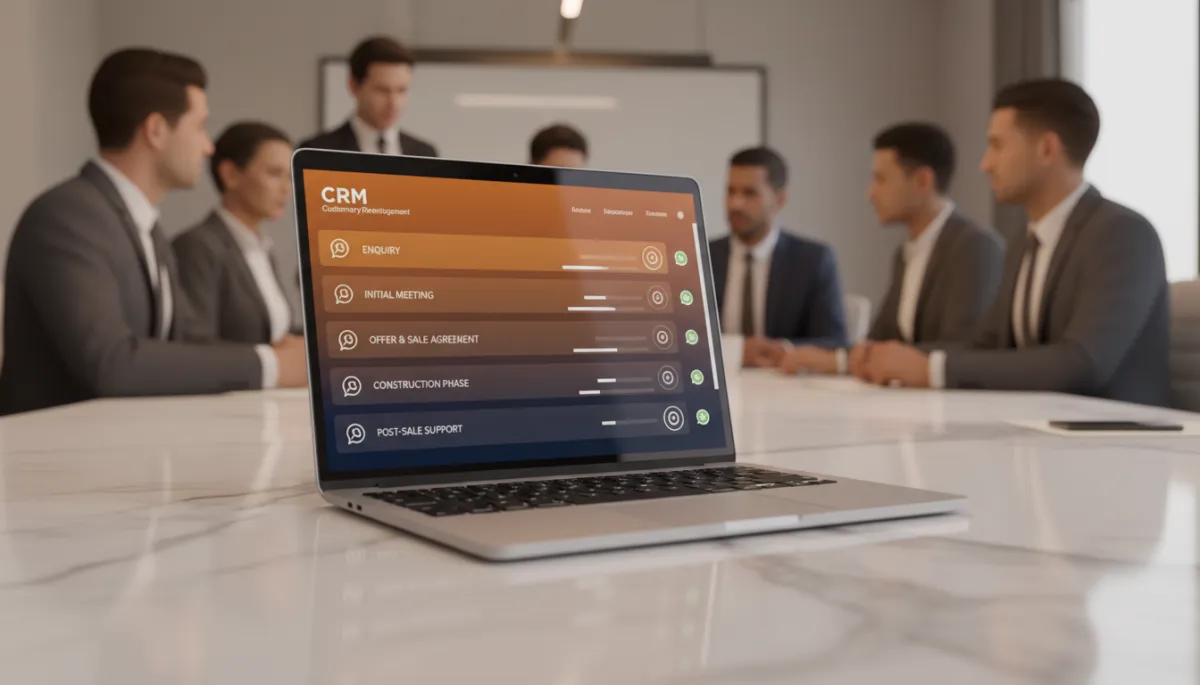
Integrated CRM and automation turn fragmented touchpoints into one coherent system.
The Long-Term ROI Argument
South Africa's housing shortage of 2.3 million units continues to drive demand, creating excellent conditions for both homeownership and investment. The opportunity is real. The fundamentals are supportive.
The South African Reserve Bank has opted to hold the repo rate at 6.75%, offering homeowners and investors a steady environment. Buyer confidence is stabilising.
The market conditions are not the constraint. The constraint is execution — specifically, how well development teams manage the buyers who are already raising their hands.
Consider this: if a development receives 800 enquiries over a six-month campaign period, and only converts 3% into sales, that's 24 units sold and 776 buyers lost. Even a 1% improvement in conversion — one buyer in 100 — adds eight units to the total. On a R2 million average unit price, that's R16 million in additional revenue from the same lead pool.
The cost of a Development Growth System is not a marketing expense. It's a revenue infrastructure investment.
Future phases become easier when the database from the current development is owned, managed, and activated — not archived. When your next development launches, the first 200 people you contact are pre-warmed buyers who've already expressed interest in your product. That changes the economics of launching entirely.
What Developers Should Do Differently Starting Today
Audit your current enquiry response time. Measure it. The average across South African developments will surprise you. If it's more than 30 minutes, you're losing sales.
Map your buyer journey. Write down every touchpoint a buyer experiences from first enquiry to OTP signature. Then identify the gaps — the moments where buyers fall silent and your team has no visibility or follow-up system.
Stop treating your database as a campaign asset. Your buyer database is a long-term business asset. Manage it accordingly. Segment it, maintain it, and plan for how it will serve your next development.
Integrate WhatsApp into your lead management infrastructure. Not as a broadcast tool. As a two-way, automated, intelligent engagement channel connected to your CRM.
Invest in reporting. Track the journey in stages — lead volume, qualified leads, lead-to-viewing rate — not just the first platform result. Visibility drives better decisions.

Strategic teams treat enquiry management as core infrastructure, not admin.
The Bottom Line
Every development enquiry represents a person who raised their hand. They saw your development, felt something, and took an action. That moment of intent is the most valuable thing your marketing produces.
What happens after that moment determines whether your development succeeds or simply generates activity.
Most developments still treat enquiry management as an administrative function. The most successful developments in South Africa are starting to understand it's a strategic one — one that requires infrastructure, automation, and a system designed specifically for the development buyer journey.
Launches end. Systems compound.
The developments being built right now on a proper growth system foundation are the ones that will launch their next phase with a warm database, a proven process, and a fraction of the acquisition cost. That's the compounding advantage. And it's available to any development team willing to build for it.
Ready to Understand What's Happening to Your Development Enquiries?
Development Funnels (Powered by Property Funnels) builds Development Growth Systems for South African property developers — combining development CRM, WhatsApp automation, AI buyer engagement, and structured buyer journey infrastructure into one connected system.
Book a Strategy Consultation and discover exactly where your development is losing buyers — and how to build a system that retains, nurtures, and converts them.
Visit: https://developmentfunnels.co.za
Launches end. Systems compound.


