

What Happens to Your Development Leads After They Register Interest? (Most Teams Don't Know)
What Happens to Your Development Leads After They Register Interest? (Most Teams Don't Know)
There's a number no development team wants to calculate.
Take your total marketing spend from the last 12 months. Add your agent commissions. Add your portal costs, your paid social budget, your Google campaigns. Now ask: how many of those leads — those real people who raised their hands — were properly followed up, nurtured and converted?
Not just contacted. Converted.
For most South African property developments, the honest answer is: fewer than you think. And the gap between leads captured and sales closed isn't a sales problem. It isn't a product problem. It isn't even a marketing problem.
It's a systems problem.
The Uncomfortable Truth About Development Lead Management
Most developments treat lead capture as the finish line. A buyer visits the website, fills in a form, downloads a brochure, or sends a WhatsApp. The lead lands somewhere — a spreadsheet, an inbox, a portal dashboard — and then the journey begins to fall apart.
Here's what typically happens next:
A sales agent gets a notification (if the setup is even that advanced)
They call once, maybe twice
If there's no answer, the lead gets marked as "not interested"
It disappears into a spreadsheet that nobody audits
The development spends more money generating new leads to replace the ones it lost
This cycle repeats every month. Every quarter. Every phase.
The developers winning in 2026 and beyond understand that this isn't a people problem — it's a pipeline problem. When you don't have a system managing every lead, every touchpoint and every follow-up sequence, you're not running a sales operation. You're running a hope strategy.
Why This Is Bigger Than You Think
South African property buyers don't make fast decisions. The average buyer journey — from first enquiry to signed OTP — can take anywhere from three weeks to twelve months, depending on the product type, price point, and buyer profile.
Lifestyle estate buyers often take six to nine months. Retirement village prospects can take over a year. Affordable housing buyers move faster but require constant reassurance and clear communication throughout.
What this means is that lead management isn't a short-term activity — it's a long-term infrastructure decision.
A buyer who doesn't convert this month is not a dead lead. They are a deferred sale. And if your system doesn't have the architecture to keep that buyer engaged, informed and emotionally connected to your development over time, someone else's development will capture that sale.
Here's what developers are missing: the cost of a lost lead isn't just the lost commission. It's the full marketing spend required to find and re-engage that same calibre of buyer six months later.
The Three Points Where Most Developments Lose Their Leads
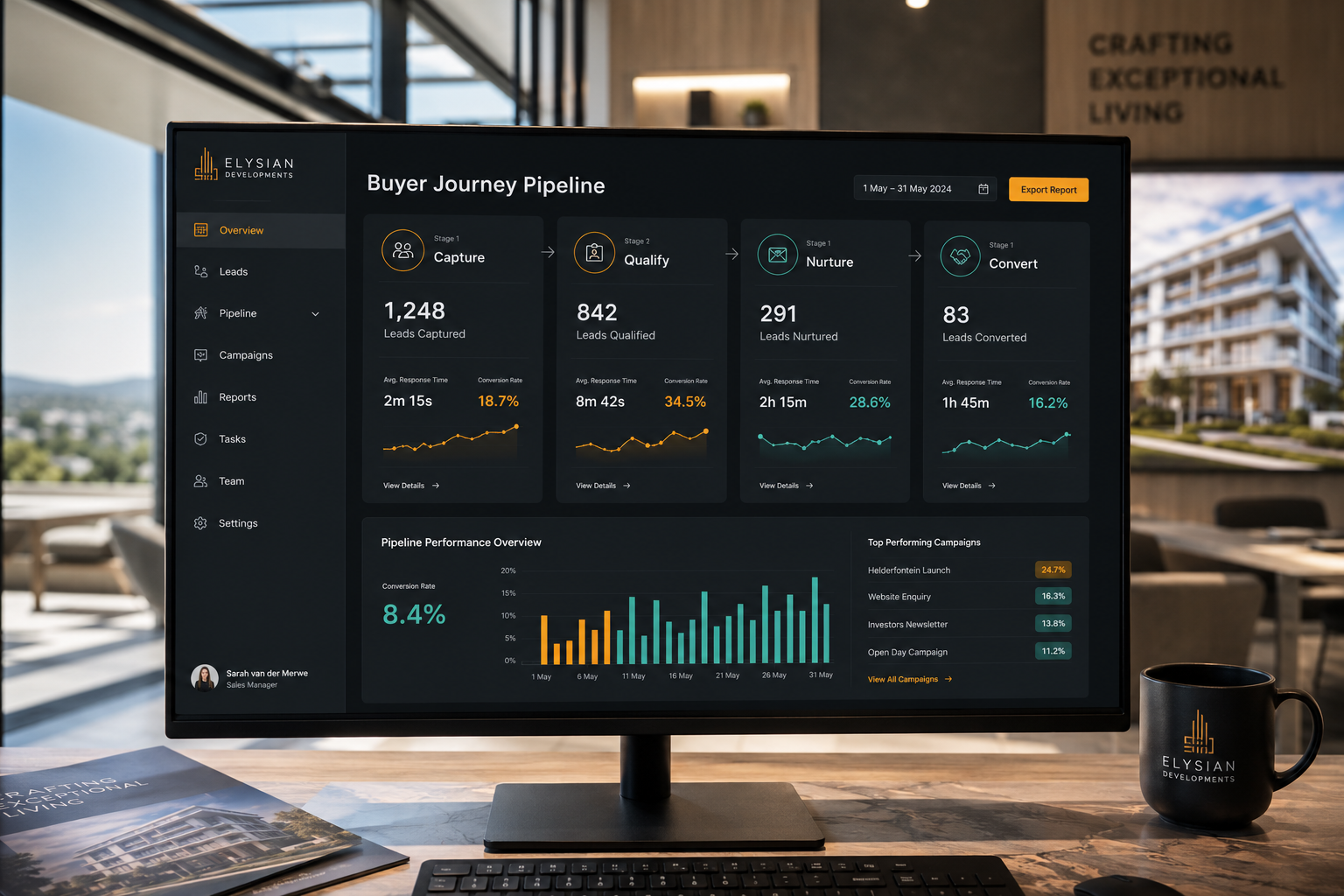
Understanding where leads are lost is the first step to fixing it. In development after development, the same three failure points repeat.
1. The Response Gap
Speed matters more in property sales than most teams realise. Research consistently shows that the probability of qualifying a lead drops significantly after the first five minutes of enquiry. Most developments take hours — sometimes days — to respond.
By that time, the buyer has visited three other development websites, received a faster callback from a competing project, and emotionally moved on.
WhatsApp automation closes this gap completely. An automated WhatsApp message that fires within 60 seconds of registration — welcoming the buyer, sharing a brochure, confirming next steps — keeps the engagement window open while your sales team prepares to follow up personally.
2. The Follow-Up Cliff
After the initial contact, most developments fall off a cliff. There's no structured follow-up sequence. No nurture journey. No scheduled touchpoints.
The reality is that most property buyers need between five and twelve meaningful interactions before they're ready to make a decision. If your follow-up system stops at interaction two, you've abandoned the majority of your pipeline before it had a chance to convert.
A development CRM with automated follow-up sequences — email, WhatsApp, SMS — keeps the conversation alive between agent touchpoints. It keeps your development top of mind during the months when buyers are researching, comparing and preparing financially.
3. The Database Black Hole
When a phase sells out or a launch period ends, what happens to the leads that didn't convert?
For most developments: nothing. They sit in a spreadsheet. They get exported. Sometimes they get imported into a new spreadsheet. But they're never actively worked, never re-engaged, and never connected to the next phase opportunity.
This is one of the most expensive mistakes in development marketing. Those unconverted leads — the ones who were genuinely interested but not yet ready — are some of the warmest prospects for your next phase launch. But only if you've maintained the relationship.
Launches end. Systems compound. A development growth system carries your database from phase to phase, retaining the relationship equity you've built, and activating it again when the timing is right.
What a Proper Development Lead Management System Looks Like
Let's make this concrete. Here's what a properly architected development growth system does at every stage of the buyer journey.
Stage 1: Capture (Day 0)
A buyer finds your development — through a portal listing, a Google search, a social media ad, a referral, or an organic article. They land on your development website. They register interest.
At this point, the system:
Captures their details into the development CRM automatically
Tags them by source, campaign, and interest level
Triggers an immediate WhatsApp welcome message
Sends a branded email with project information and next steps
Notifies the assigned agent with full lead context
All of this happens in under 60 seconds. Without a single manual action from your team.
Stage 2: Qualification (Days 1–7)
Over the first week, the system runs a structured qualification sequence. This includes:
A follow-up WhatsApp asking about timeline and interest level
An email with a virtual tour or video walkthrough
A brochure sequence timed to their registration date
Agent follow-up tasks automatically assigned with context
The buyer feels engaged. The agent has everything they need to have a meaningful conversation. And the CRM records every interaction, every open, every click — so your team can see exactly where each buyer is in their journey.
Stage 3: Nurture (Weeks 2–52+)
This is where most developments have nothing. This is also where the biggest opportunity lives.
A long-term nurture sequence keeps your development present in the buyer's mind throughout their research and decision-making process. This includes:
Monthly development updates and construction progress
Educational content about the buying process
Community and lifestyle content relevant to your development
Milestone communications (construction phases, launch events, limited availability alerts)
Re-engagement campaigns timed to market events
The buyers who aren't ready today don't disappear from a system. They stay in the pipeline, warm and informed, until their moment arrives.
Stage 4: Conversion (Whenever the Buyer Is Ready)
When a buyer is ready to move, a properly managed pipeline means your sales team doesn't need to start from scratch. They have a full history of every interaction, every piece of content the buyer engaged with, and a clear picture of their journey.
This makes the closing conversation natural, personal and efficient. The buyer already knows your development. They trust your communication. They've been educated throughout the process.
This is what transforms a development sales operation from reactive to proactive.
The Reporting Question Every Development Director Should Ask

Here's a simple test. Ask your sales team right now:
How many active leads are currently in the pipeline?
How many of those leads have been contacted in the last 14 days?
What's the average response time to new enquiries?
Which marketing channel is producing the highest quality leads?
How many leads from three months ago are still being nurtured?
If your team can't answer these questions immediately, with data — not estimates — you don't have a lead management system. You have a lead collection system. And those are very different things.
A development growth system gives you real-time visibility into every one of these metrics. Not at the end of the month. Not in a quarterly report. Now.
Practical Steps: Where to Start

If this article is describing your development's current reality, here's where to begin.
Audit your current lead journey — Map out what actually happens to a lead from the moment they register to the moment they sign — or disappear. Be honest. Most teams discover they have no real journey; they have a series of uncoordinated actions.
Centralise your database — Every lead, from every source, needs to live in one place. One CRM. One view. One source of truth. If your leads are split across portals, spreadsheets, agent inboxes and WhatsApp chats, you can't manage what you can't see.
Automate your first 48 hours — The response gap is the most fixable problem. WhatsApp automation that fires within 60 seconds of registration will immediately improve your lead engagement rate. Start here before anything else.
Build a 90-day nurture sequence — You don't need a perfect system on day one. Build a 90-day email and WhatsApp sequence that educates, updates and engages buyers who haven't yet converted. This alone will recover deals your team has already written off.
Implement reporting from week one — You can't improve what you don't measure. Even a basic dashboard showing lead volume, response time and conversion rate will give your team the visibility to make better decisions every week.
The Long-Term Advantage: Systems That Compound
Here's the philosophy that separates development teams that consistently sell from those that constantly scramble.
A launch is a moment. A system is a machine.
When you run a launch without a system, you spend aggressively, generate leads, convert some, lose the rest, and then start from scratch for the next phase. Every launch costs the same. Every launch feels the same. Every launch carries the same risk.
When you build a system, something different happens. Your database grows with every phase. Your nurture sequences improve with every cycle. Your marketing intelligence compounds — you know which channels work, which messages convert, which buyer profiles close fastest.
Future phases become easier because your database is warmer. Your marketing costs drop because your organic reach grows. Your sales velocity improves because your buyers arrive more educated and more trust-ready.
Launches end. Systems compound.
This isn't a philosophical position. It's the financial reality of development marketing done properly over a multi-phase horizon.
Conclusion

The question "what happens to your leads after they register?" shouldn't be a mystery. It should be a documented, measurable, continuously improving process — visible in real time to your entire sales and marketing operation.
Most South African developments are leaving significant revenue on the table not because their product is wrong, or their marketing is weak, but because their systems aren't built to carry leads from registration to signature with the consistency buyers expect and the efficiency teams deserve.
Development lead management isn't about technology for its own sake. It's about building the infrastructure to honour every lead, respect every buyer's journey, and compound the value of every rand you invest in generating interest.
The developments that understand this don't just sell phases. They build growth systems.
Ready to Understand Your Full Buyer Journey?
If you're ready to see what a properly architected development growth system looks like — from first enquiry through to signed sale — we'd like to show you.
Book a Strategy Consultation at developmentfunnels.co.za and let's map your current buyer journey, identify where you're losing leads, and design the system your development deserves.
You can also explore buyer journey automation and development CRM examples at propertyfunnels.club.
Because launches end. But systems compound.


