
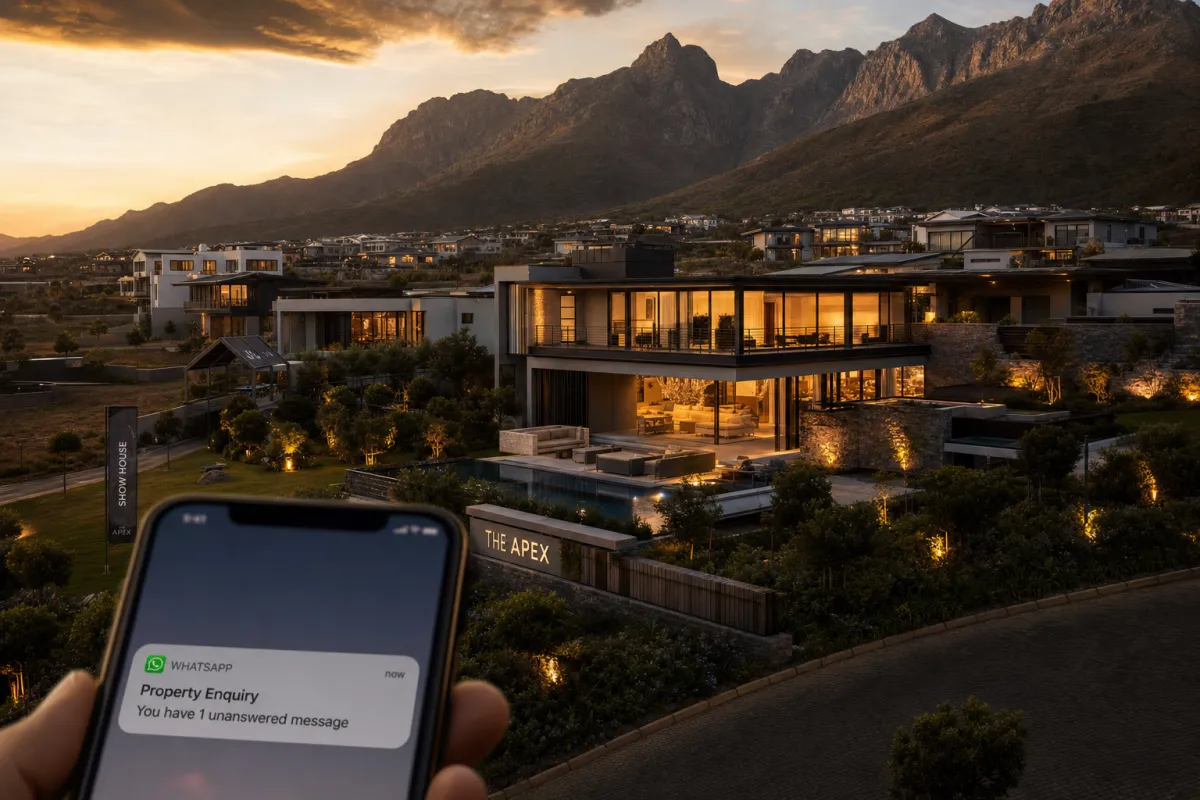
What Happens to Every Enquiry? The Buyer Journey Gap South African Developers Are Missing
What Happens to Every Enquiry? The Buyer Journey Gap South African Developers Are Missing
The Moment Everything Falls Apart
A buyer finds your development.
Maybe it is an Instagram ad for a lifestyle estate in the Boland. Maybe it is a Google search for off-plan apartments in Umhlanga. Maybe it is a recommendation from a colleague about a retirement village in Pretoria.
They click. They fill in the form. They send the WhatsApp.
And then — what?
For most South African developments, the honest answer is: not enough. Or not fast enough. Or not consistently enough.
The enquiry arrives. Someone follows up — eventually. The buyer is still in research mode. The follow-up message lands too early or too late. The sales consultant does not have the right context. The buyer slips quietly into another development's process.
You spent budget acquiring that lead. You lost the buyer at the follow-up.
This is the buyer journey gap. And it is quietly costing South African developers millions in lost sales every year — not because of bad products, but because of broken systems.
The Problem: Development Marketing Ends Too Soon
Most development marketing strategies are built around a single objective: generate enquiries.
The campaign launches. The leads come in. The budget goes to media spend. And the moment an enquiry is generated, the developer's system — for all practical purposes — ends.
What replaces it? A spreadsheet. A WhatsApp group. Someone's inbox. A CRM that is half-implemented and barely adopted.
The uncomfortable truth is that enquiry generation is the easiest part of development marketing. It is what happens after the enquiry that determines whether your development hits its unit targets — or misses them.
Most developments still treat enquiry management as a sales team problem. The reality is that it is a systems problem. And no amount of additional headcount solves a systems problem.
What the Modern South African Property Buyer Actually Does
Before we examine the gap, it helps to understand the buyer.
South African property buyers — whether purchasing a sectional title unit in Johannesburg, a retirement home in Stellenbosch, or an affordable housing unit in Cape Town — are doing more research than ever before. They compare. They delay. They revisit. And they expect fast, relevant communication at every step.
Here is what a modern buyer journey actually looks like:
Stage 1: Awareness
The buyer encounters your development via Google, social media, a Property24 listing, or word of mouth. They are curious — but entirely uncommitted.
Stage 2: Consideration
They visit your website, watch your video tour, download your brochure. They compare your development against others. They ask questions. They go quiet. They come back two weeks later.
Stage 3: Intent
Something shifts. A bonus. A life event. A conversation with their partner. They enquire.
Stage 4: Decision
They are evaluating. This is where speed of follow-up, quality of communication, and trust-building determine whether they sign — or walk.
Stage 5: Commitment
They are ready. But only if your sales process made it easy, consistent, and reassuring to reach this point.

Here is what most developers miss: the buyer is active at every stage — not just when they submit a form.
If your development only responds to Stage 3 and ignores Stages 1, 2, 4, and 5, you are leaving the buyer journey entirely to chance.
The Enquiry Audit Most Developers Have Never Done
Pull your last 100 enquiries. Then answer these questions honestly.
How fast did you respond? Within 5 minutes? Within an hour? The next morning?
How many follow-ups did you send? One? Three? None after the first unanswered call?
What did your follow-up say? Was it personalised? Or a generic just checking in message?
What channel did you use? Email only? Did you WhatsApp? Did you call?
What happened to enquiries that did not convert immediately? Did they enter a nurture sequence — or disappear entirely?
Do you know which of those leads eventually bought at a competitor?
If you cannot answer most of these questions, you do not have a buyer journey. You have a process that starts and stops at the enquiry form.
The Three Follow-Up Failures
Across South African property developments, three failure patterns repeat consistently.
1. The Speed Problem
Response time in the first few minutes of an enquiry dramatically increases conversion. In property — where buyers are often in a heightened emotional state when they reach out — speed is a trust signal.
If a buyer submits an enquiry on a Sunday afternoon and receives no response until Monday morning, they have already engaged with the next development on their list.
Most development sales teams are not structured — nor resourced — to respond at this speed consistently. That is not a criticism. It is a structural reality. And it is exactly why automated initial responses, WhatsApp acknowledgement, and AI-assisted engagement have moved from nice-to-have to essential infrastructure.
2. The Personalisation Problem
Hi, thanks for your interest in our development. A consultant will be in touch shortly.
This is the most common initial response across South African property developments. And it does almost nothing.
The buyer signalled something when they enquired. They specified a unit type. They indicated a timeline. They came from a specific campaign that told you exactly what they were looking for.
None of that should be wasted. A development CRM that captures source, channel, unit preference, and enquiry context — and routes that information to the sales consultant instantly — enables personalised, relevant follow-up from the first touchpoint.
Personalisation is not a luxury. In a competitive development environment, it is the difference between a buyer who feels seen and a buyer who feels like a number.
3. The Nurture Problem
This is where the biggest volume of lost sales quietly accumulates.
A buyer enquires. They are not ready to commit today. The sales team follows up twice, gets no response, and marks the lead cold. They are never contacted again.
Three months later, that buyer purchases at a competitor development.
The problem is that not ready now does not mean never. In property development — especially off-plan — buyers can take three, six, or even twelve months from first enquiry to purchase decision. A development with no nurture system loses every single one of those slow-burn buyers. A development with a structured buyer journey stays top of mind throughout that entire cycle.
What a Development Growth System Does Differently
This is where systems outperform campaigns.
A Development Growth System does not just generate enquiries. It manages the entire buyer journey — from first click to signed OTP — with infrastructure that ensures no lead is left unattended and no relationship goes cold by accident.
Development CRM: The Central Intelligence Layer
A development-specific CRM tracks every lead — their source, their stage, their interactions, their preferences. It gives your sales team live visibility into every buyer in the pipeline, and it triggers automated actions based on buyer behaviour.
Did the buyer open the brochure? The CRM knows. Did they visit the website three times in one week? The CRM flags it. Did they go quiet after two follow-ups? The CRM initiates a re-engagement sequence.
This is not generic CRM functionality adapted for property. Development CRM is built around the specific stages, timelines, and decision drivers of the property buying process.

WhatsApp Automation: Meeting Buyers Where They Are
South Africa has one of the highest WhatsApp usage rates globally. Property buyers use it constantly. Yet most developments still default to email as their primary communication channel.
WhatsApp automation changes this. An enquiry comes in at 10pm on a Saturday. Within seconds, the buyer receives a WhatsApp message — personalised, professional, and immediately useful. A brochure link. A video walkthrough. A price list. A link to book a show house appointment.
The buyer feels acknowledged. The trust-building begins. Your competitor who responded Monday morning lost before the week even started.

Buyer Journey Automation: The Long Game
Automated buyer journeys — triggered by time, behaviour, or pipeline stage — keep your development top of mind throughout the entire decision cycle.
Week 1: Welcome sequence. Brochure. Virtual tour link.
Week 3: Value-add content — location benefits, lifestyle angle, community features.
Week 6: Milestone update — construction progress, units remaining.
Week 10: Social proof — testimonial from a buyer who recently secured.
Week 16: Urgency trigger — final units in a specific configuration.
This is not spam. This is relevant, timed, valuable communication that respects where the buyer is in their journey and keeps your development present in their decision-making.
AI Buyer Engagement: Scale Without Compromise
AI-assisted engagement allows developers to respond to complex buyer questions — unit availability, pricing, process queries, specification requests — instantly and at scale, without depending entirely on sales consultant availability.
This is not about replacing your sales team. It is about ensuring buyers receive value from your development at any hour, on any day, so that when they are ready to talk to a human, they arrive warm, informed, and already trusting.
The Long-Term ROI Developers Are Not Calculating
Here is what most development directors miss when evaluating marketing spend.
The cost of an unconverted lead is not just the lead generation cost. It is the lead generation cost, plus the opportunity cost of the lost sale, plus the compounding cost of rebuilding from scratch for the next phase.
A development that builds a proper buyer journey database does not start at zero for Phase 2. They launch with:
Every previous enquiry who did not buy in Phase 1 and may now be ready
Every Phase 1 buyer who has a friend, colleague, or family member searching
Every referral contact who was warm but never formally followed up
Twelve months of buyer journey data that informs smarter phase targeting
Future phases become easier when the system compounds.
The developers winning in 2026 and beyond understand that their database is their most valuable development asset — more valuable than any single campaign, any single site launch.
They are not measuring success by enquiry volume. They are measuring by enquiry-to-show-house conversion. By show-house-to-OTP rate. By cost per sold unit — not cost per lead.
They are building systems, not running campaigns.
Practical Steps to Close the Buyer Journey Gap
If you are ready to move from a campaign-dependent model to a systems-powered development, here is where to begin.
Audit your current response speed. Measure your average response time across every enquiry channel. The number may be uncomfortable — but it is the most important baseline you can establish.
Map your actual buyer journey. Write out every touchpoint a buyer experiences from enquiry to OTP. Count how many are automated versus entirely manual. The ratio will tell you everything.
Centralise your lead data. If your leads live across a portal, a spreadsheet, a shared inbox, and someone's personal WhatsApp — consolidate them. You cannot optimise what you cannot see.
Implement WhatsApp acknowledgement as a minimum. Ensure every enquiry receives an immediate, personalised WhatsApp response within minutes. This single change will improve buyer engagement and trust before any other automation is in place.
Build a 90-day nurture sequence. Create automated touchpoints that provide genuine value over 90 days post-enquiry. Not sales pressure — useful information, updates, and relationship-building content that keeps your development relevant throughout the decision cycle.
Define and track your pipeline stages. Know exactly what stage every buyer is at, every day. Visibility creates accountability. Accountability drives conversion.
The Enquiry Is Just the Beginning
The enquiry is not the destination. It is the starting point of a relationship that — if managed correctly — ends in a sale.
Most South African developments treat the enquiry as the finish line for their marketing system. The most successful ones treat it as the opening of their sales system.
The buyer journey gap is real. It is measurable. It is costly. And it is closeable — but only with the right infrastructure in place.
Launches end. Systems compound.
Development Funnels is a Development Growth System built to close this gap permanently — managing the entire buyer journey from first click to signed OTP with the CRM, automation, WhatsApp, and AI infrastructure that modern South African development sales demands.
Ready to See What Is Happening to Your Enquiries?
If you want to understand exactly where your buyer journey is breaking down — and build the system to convert more of your enquiries into sales — let's talk.


